Fourth Presbyterian Church
Michigan Avenue and Delaware Place, Chicago, IL
About Fourth Presbyterian Church
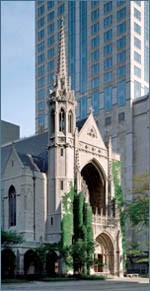
Fourth Presbyterian Church is located at the corner of Michigan Avenue and Delaware. The doors to the sanctuary are located on Michigan Avenue; an accessible entrance to the sanctuary is located through the glass doors 50 feet south of the main sanctuary entrance on Michigan Avenue.
Parking
Discounted weekday evening parking is available for $11 at the 900 North Michigan garage (access at Rush or Walton) for entry after 5 PM. To park in this garage, you must download the Metropolis parking app and create an account. You will then receive a QR code at the performance to scan with your smartphone. Click here for detailed instructions about this parking option.
If you plan to park in the area before 5 PM, we recommend that you check out Spothero or ParkWhiz for discounted rates.
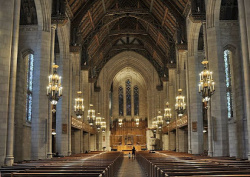
Seating just under 800, Fourth Presbyterian Church hosts many arts events throughout the year, including a free weekly Friday Noon Concert Series and occasional evening and weekend performances.
Since 1914, more than 8 million people have entered under the carved stone tympanum over the Michigan Avenue entrance to Fourth Presbyterian Church. Most of the interior and exterior of the church is “original,” looking just as it has for almost a century. The cornerstone was laid in 1912, and the building was dedicated in May 1914. Except for the Old Water Tower, Fourth Presbyterian Church is the oldest building on Michigan Avenue north of the Chicago River.
The architect of Fourth Presbyterian Church was Ralph Adams Cram, America’s leading Gothic revival architect, best known for his work on the world’s largest Gothic cathedral, the Cathedral of St. John the Divine in New York City. Fourth Presbyterian Church is not a “copy” of any one building but instead combines what Mr. Cram saw as the best of English Gothic and French Gothic styles.
Prominent Midwestern architect Howard Van Doren Shaw designed the parish buildings (the Tudor-style structures surrounding the courtyard), which were built at the same time as the church and dedicated in March 1914.